


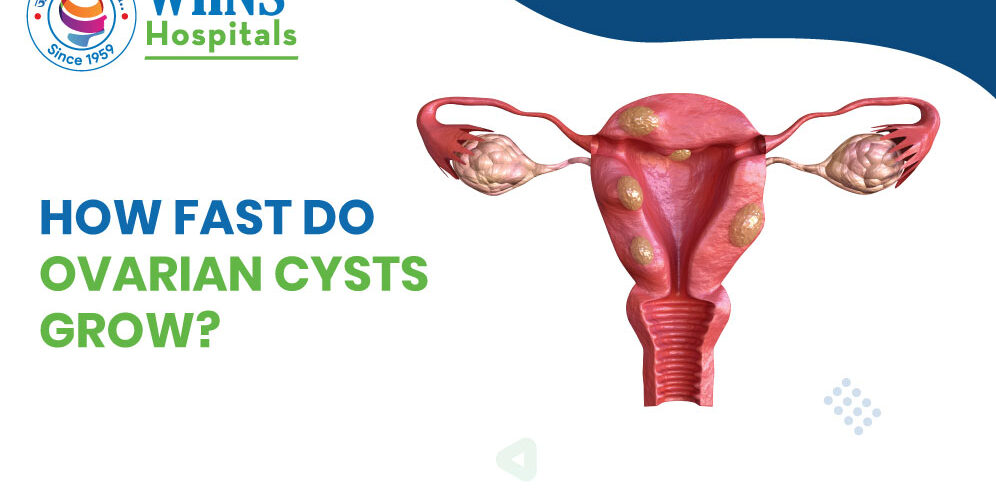
Having an ovarian cyst on the surface or inside your ovaries might seem complex, but these are often quite common, particularly in women of childbearing age. At WIINS Hospitals, Kolhapur, our gynecology team regularly diagnoses and treats ovarian cysts, ensuring safe and personalized care for every patient. In most cases, ovarian cysts are benign (non-cancerous).
If the cysts grow large or cause symptoms, such as persistent pain in the pelvis and painful intercourse, you may need to visit a gynecology hospital in Kolhapur to rule out serious conditions. In the meantime, we’ll take a look at the rates at which ovarian cysts tend to grow.
Types of Ovarian Cysts
The growth pattern of an ovarian cyst depends largely on its type.
Functional Cysts
Functional cysts are normal and are connected to your menstrual cycle. Each month, a fluid-filled sac grows in your ovary and ruptures when the egg is released. It’s then dissolved. If the egg doesn’t mature or is not released, a follicular cyst may form.
Sometimes, after the egg is released, the follicle (instead of getting dissolved) gets filled with fluid. This also forms a cyst. Both types are common and usually dissolve in 1-3 months. Functional cysts are usually small, often 2–3 cm, but in some cases, they can grow larger before resolving on their own.
Pathological Cysts
Pathological cysts are not related to your menstrual cycle. They have unique growth patterns, depending on their type.
- Dermoid Cysts: A dermoid cyst can contain tissues, including skin, hair, and even teeth. They typically grow slowly over years, but the rate can vary. While often less than 2 mm per year, they may still reach large sizes if left untreated.
- Endometriomas: Endometriomas, also called chocolate cysts due to the old blood they contain, are linked to endometriosis, where endometrial-like tissue grows outside the uterus.
- Cystadenomas: These develop from ovarian tissue (located on the surface of the ovaries) and may be filled with mucus or fluid. Cystadenomas can grow slowly or rapidly, and in some cases may reach very large sizes, requiring surgical removal.
Typical Growth Patterns
Average Growth Rates: Some cysts grow larger over time, while others might dissolve. Functional cysts, as mentioned above, dissolve on their own, while dermoid and endometriomas keep growing gradually.
Symptoms to Watch out for:
See a gynecologist in Kolhapur if you notice these symptoms:
- Sharp or dull pain in the abdomen
- Persistent bloating
- Changes in your menstrual cycle
- Painful intercourse
Diagnostic Methods
An ultrasound is the first-line test to detect ovarian cysts, determine their size, and assess whether they appear simple or complex. Your gynecologist may also use it to track the growth of the cyst. Further imaging tests may be necessary if the cyst appears abnormal on ultrasound.
An MRI can give a detailed picture of the cyst. Sometimes, a blood test may be necessary to rule out ovarian cancer, especially in women above 40 or with a family history of ovarian cancer.
Treatment Options
Monitoring: If you have a functional cyst, watchful waiting is all that’s needed. You may need ultrasounds if your doctor recommends them, but in most cases, the cysts will disappear without requiring treatment.
Hormonal Therapy: Medication to regulate your menstrual cycles, such as birth control pills, can make your cycles more predictable and prevent follicular cysts.
Surgical Interventions: Surgical removal may be necessary if a cyst is larger than 5–10 cm, persists over time, causes symptoms, or shows suspicious features suggesting cancer.
Most ovarian cysts are harmless. However, it’s important to attend regular check-ups, watch out for unusual signs, and discuss your symptoms with a gynecologist to be on the safe side.