


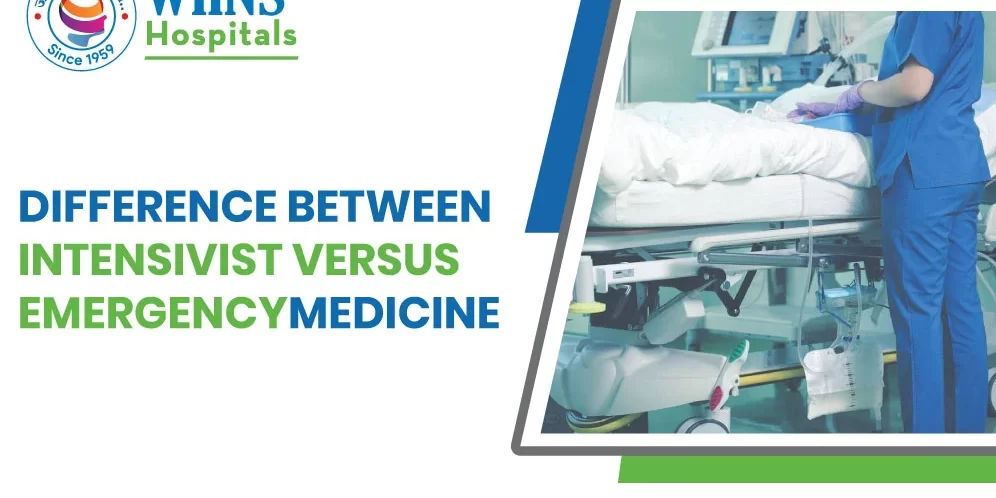
Medical emergencies can arise without indications. The first step people take in such emergencies is taking the patient to the nearest hospital. WIINS Hospitals, known for its expert intensivists in Kolhapur, provides immediate and specialized care for critically ill patients. You may have come across the two commonly used terms “ICU” and “Emergency”. Many people believe they are interchangeable terms, but both have distinctive features and serve different cases. In this post, we’ll take a detailed look at intensivists vs emergency medicine.
What is an Intensivist?
An ICU (Intensive Care Unit) is a room dedicated to critically ill patients battling severe medical illnesses. Patients who require round-the-clock monitoring of their vitals are referred to the ICU, where a team of professional intensivists, hospital staff, and caretakers looks after them. An ICU is equipped with advanced monitoring and diagnostic tools that can help assess patients’ health and help intensivists with decision-making.
What is Emergency Medicine?
As the name suggests, Emergency Departments are for patients with severe injuries, such as a gunshot wound, a brain injury from a car accident, or a sudden heart attack or a brain stroke. They are admitted to the Emergency Room. The main focus of the specialists in the ER is to stabilize the patients’ condition by providing immediate medication that offers quick relief.
In an ER in the best critical care hospital in Kolhapur, you will find a team of doctors who work hard to get the patient out of danger. Once the patients’ condition is stabilized, the doctors decide the next course of action—whether to discharge the patient or shift them to the ICU.
Key Differences
Work Environment
Intensivists work in ICUs where patients requiring ongoing medical support are admitted. An emergency doctor, on the other hand, works in the emergency room where their primary focus is to save the patients’ lives with prompt medication.
Patient Care Duration
In an ICU, a patient stays for days, weeks, or sometimes, months until they are stable enough to be moved to the general ward or sent home. The stays in an ICU are usually longer, requiring comprehensive treatment plans and constant life support. Emergency medicine is short-term medical care. Once the patient is out of danger, they are immediately moved to the ICU, to another hospital, or are discharged based on their health.
Scope of Practice
An intensivist is needed in case of cardiac issues, such as a heart attack, congestive heart failure, or severe respiratory issues that require oxygenation and ventilation. Those who have undergone serious surgeries, such as a hysterectomy or a coronary artery bypass grafting, may require monitoring in the ICU.
Patients with traumas, severe pain, asthma attacks, sudden illnesses, or severe allergic reactions are given emergency care.
Conclusion
Both emergency rooms and ICUs serve a crucial role in saving patients’ lives and giving them a chance at living a normal, quality life after recovery. Although they share similarities, such as offering specialized care to the critically ill patients, they are different in terms of scope, focus, level of care, and staff skills. Knowing the differences will help you approach the best hospital.