

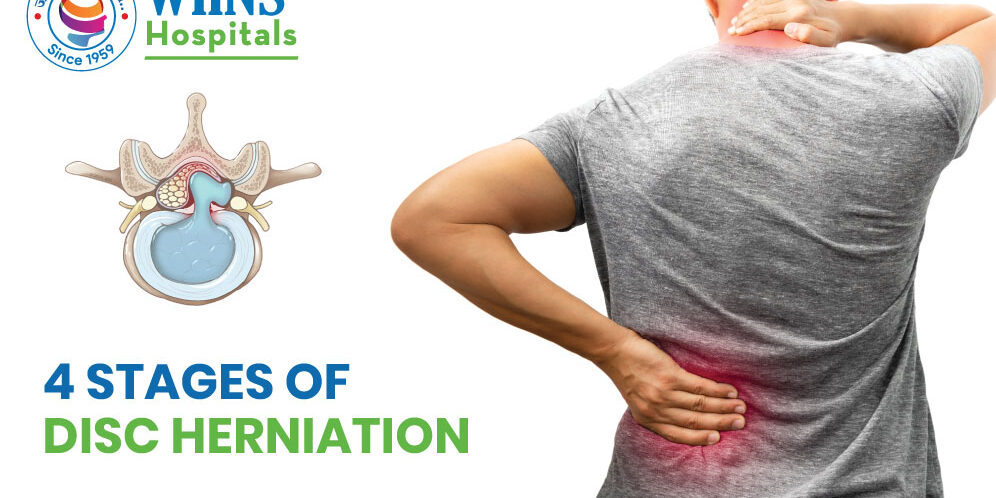
The bones forming your spine are called vertebrae. These bones are protected by the small, soft discs, which act as shock absorbers. These discs keep your spine flexible and allow you to perform multiple movements, like bending and twisting. You may need to see a neurosurgeon in Kolhapur at WIINS Hospitals, if any of these discs become herniated or displaced. A herniated disc occurs when the inner, soft portion of the disc pushes out through small tears or cracks in the outer layer. The inner, soft portion of the disc might come out and press on the surrounding nerves, causing immense pain, numbness, and a tingling sensation. This doesn’t happen overnight. Here are the four stages of a disc herniation.
Stage 1: Disc Degeneration
At this stage, the disc begins to lose hydration and strength. It may develop small tears, making it more prone to herniation later. This is considered an early change, not yet a true herniation. Your disc is made up of two parts. The outer layer is a ring of cartilage, called annulus fibrosus, and the inner part has a jelly-like structure. Repetitive strain to the disc, poor posture, advanced age, and heavy lifting are a few factors that can cause tears or cracks in your disc. Symptoms aren’t very pronounced at this stage, but you might experience mild discomfort in your neck or back, especially after sitting for longer periods. With the right preventive measures, disc degeneration can often be slowed at this point.
Preventive Measures
- Practice stretching regularly
- Maintain a good posture
- Drink plenty of water
Stage 2: Prolapse
In the second stage, often called protrusion or prolapse, the inner disc material pushes against the outer layer (annulus fibrosus) but remains contained within it. Since the inner part hasn’t yet penetrated through the outer shell, symptoms are still manageable. You might experience a dull ache in the back or neck. The pain might radiate to the arms and legs and is accompanied by a tingling sensation and numbness.
Treatment
Non-invasive treatment options for a prolapsed disc include physical therapy, anti-inflammatory medicines, and lifestyle changes.
Stage 3: Extrusion
The disc might actually penetrate through the outer shell. At this stage, the inner disc material breaks through the outer layer and extends beyond the disc boundary. It may still remain connected to the main disc. The pain is comparatively more intense than the above stages. It’s described as a sharp and shooting pain that affects your lower back and interferes with your ability to sit, stand, walk, and perform your routine tasks easily. Other symptoms include tingling and numbness.
Treatment
You must seek disc herniation treatment in Kolhapur if you have the above symptoms. The doctor may recommend corticosteroid injections, medications, and physical therapy. If symptoms worsen or neurological weakness develops, surgery may be considered. to help manage pain and bring the inflammation down.
Stage 4: Sequestration
This is the most advanced stage of disc herniation, where the inner jelly-like structure not only comes out of the outer shell, but detaches itself from the disc. This leads to a free fragment in your spinal canal. You might experience persistent, excruciating pain with loss of mobility and sensation. In rare, severe cases, patients may lose bowel or bladder control. This is a medical emergency and requires urgent surgical attention.
Treatment
Non-invasive treatment may still be considered if the pain is manageable. Physical therapy with pain-relief medications can help manage symptoms, but in some cases, a surgery to remove the free fragment that presses on the nerves (discectomy) is necessary. In some cases with mild symptoms, pain medications and therapy may help. However, if there is severe pain, nerve compression, or neurological loss, surgery (such as microdiscectomy) is usually required. Disc replacement is an option in selected cases, but most patients benefit from standard surgical decompression.