


Small, hard deposits of minerals that form in the kidneys are known as kidney stones. They develop when certain minerals and salts become highly concentrated in the urine. Larger stones can cause severe pain, especially when they move through the ureters, making timely medical attention important. At WIINS Hospitals, patients can receive expert evaluation and treatment from experienced specialists. If the pain becomes intense or persistent, visiting a urology hospital in Kolhapur becomes essential.
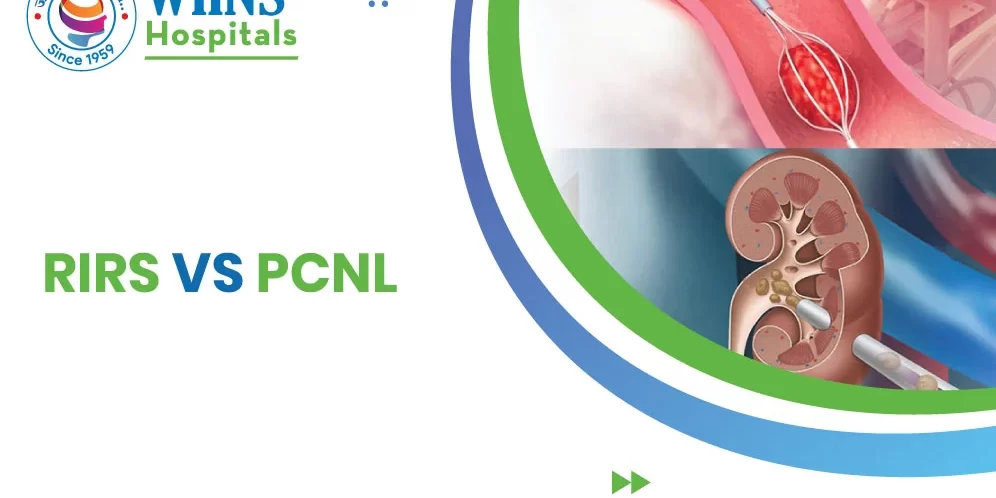
Among the many advanced treatment options for kidney stones, RIRS (Retrograde Intrarenal Surgery) and PCNL (Percutaneous Nephrolithotomy) are widely discussed. Both might sound technical, but are fairly simple. The question is, how do you decide the right treatment? Let’s understand each.
Retrograde Intrarenal Surgery
RIRS is an incision-free, surgical procedure in which your natural urinary tract is used to access your kidneys. A thin, flexible tube, called a ureteroscope, is passed through the urethra to your bladder and up the ureters until it finally reaches the kidneys.
Your surgeon can look inside your kidney through a ureteroscope. They break the stone into smaller pieces, which are either manually removed during the surgery or left to pass on their own through urination. RIRS is ideal for small stones. Since the procedure is minimally invasive and requires no major cuts, you can expect less bleeding and a shorter recovery.
Percutaneous Nephrolithotomy
PCNL is another surgical approach that aims to access the stones directly through a small cut in your back. The major advantage of PCNL is that it removes stones instead of fragmenting them, making it an appropriate choice for treatment of larger or multiple stones.
It’s comparatively more invasive than RIRS, but it is designed mainly for cases where laser fragmentation might not be enough to remove large or complex stones. It’s still less invasive than open surgery, which involves a large cut to access the kidneys.
RIRS vs PCNL: Which is Better
So, which among RIRS and PCNL is better? Which is safer? RIRS is a suitable choice for small-to-mid-sized stones, preferably less than 2 cm and located in the renal pelvis, upper or middle pole.
PCNL, on the other hand, is recommended for larger stones, located deep in the kidneys, and are harder to access via a ureteroscope. A urologist in Kolhapur will carefully review your medical history, the size and location of your kidney stones, and your overall health to determine an appropriate treatment.
Recovery
Recovery for both procedures varies greatly. RIRS is one of the least invasive approaches for kidney stone removal, thus ensuring smoother and faster recovery. You can expect minimal post-surgical discomfort and a shorter hospital stay. Most patients resume work and routine tasks within a few days. PCNL, although a minimally invasive surgery, has a relatively longer recovery. The surgeon might use a drainage tube to support healing.
Conclusion
Urologists do not see RIRS and PCNL as competing procedures, but as modern advancements in urology. Both are highly effective in treating stones of different sizes. One is less invasive and is ideal for small stones, and the other is more powerful. Knowing the differences between the two will help you make a more informed decision.