


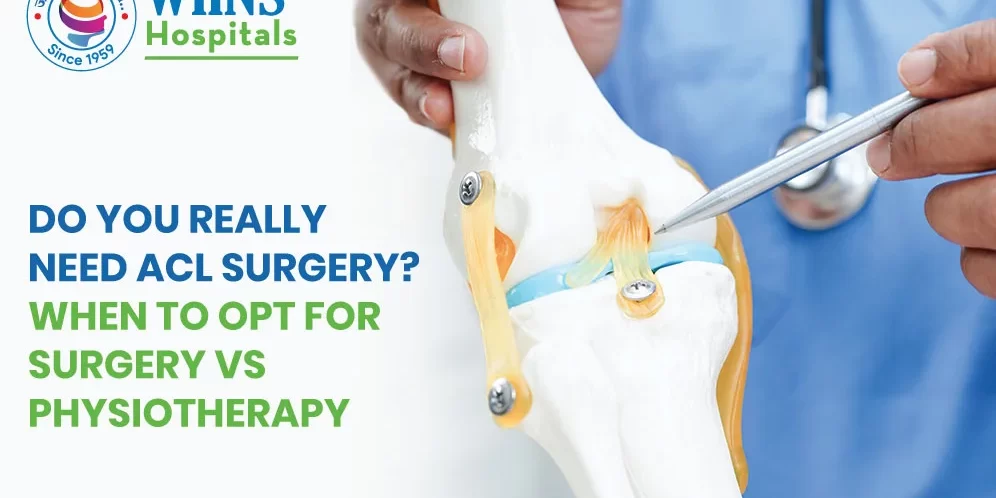
A sudden twist or turn or an awkward landing can sometimes cause knee pain followed by swelling. This can indicate a torn ACL. It doesn’t always need surgery. Physiotherapy can effectively restore your normal movements, but for complex injuries with complete tears, surgery may be the best treatment option.
Do You Really Need ACL Surgery? When to Opt for Surgery vs Physiotherapy
The anterior cruciate ligament provides stability to your knee joint. When it’s torn, it feels like your knee is about to give way. There’s no quick fix or oral pills that can magically treat a torn ACL. In fact, earlier, most people would need a surgical reconstruction, which involved long recovery periods.
Now, professionals at orthopedic hospitals in Kolhapur, such as WIINS Hospitals, explore non-invasive treatments first. Some still require surgery and physiotherapy, while others may see improvement with physiotherapy alone. The best course of treatment depends on your individual case.
ACL Injury: What Is It?
The ACL is one of the biggest stabilizers for your knee joint. An injury to the ACL occurs when the ligament is torn. ACL injuries occur when there’s a blow to your knee or when you perform a sudden, awkward movement that strains your knee. Here’s what people experience when they have a torn ACL:
- A pop sound after the injury
- Extreme pain followed by swelling
- Difficulty keeping your knee straight or bending it
- Your knee feels like it might collapse or give way when you put weight on it
The injuries are more common in people playing contact sports.
Does Every ACL Tear Require a Surgical Fix?
No, not every torn ACL needs reconstruction. The treatment depends largely on your age, lifestyle, and what kinds of activities you’d like to return to. Over time, your quadriceps and hamstrings muscles learn to adapt and compensate for the ACL, providing enough stability for your day-to-day activities. For these people, physiotherapy alone may be enough.
Physiotherapy for Torn ACL
Physiotherapy aims to train your muscles to support your knee joint. After an ACL injury, you may become cautious about your movements. Whether it’s walking or climbing stairs, you might feel scared to put weight on the affected knee.
Physiotherapy doesn’t just focus on exercises, but also on reducing swelling and inflammation. In the initial weeks, your therapist will focus more on controlling pain and swelling through ice therapy, compression, and gentle movements.
It helps strengthen your knee joint and boosts your confidence, making normal movements feel “normal”. Controlled squats, step-down training, and lunges are a few exercises that reduce joint stiffness, strengthen the knee joint, and improve knee stability.
When is Surgery Needed?
Picture this — you are an athlete with a torn ACL, eager to get back to your sports life. You are young and want to continue playing football, basketball, or contact sports. Or, you are simply someone with a simple, less-active life, but a severely torn ACL that affects even basic movements, such as walking. Both cases require a surgical intervention. If your knee feels unstable or gives way repeatedly, the risk of secondary injuries, such as a meniscus tear or cartilage damage, may increase. An ACL surgeon in Kolhapur recommends a surgical reconstruction, not just to restore your knee’s stability, but to ensure its protection in the long run.