


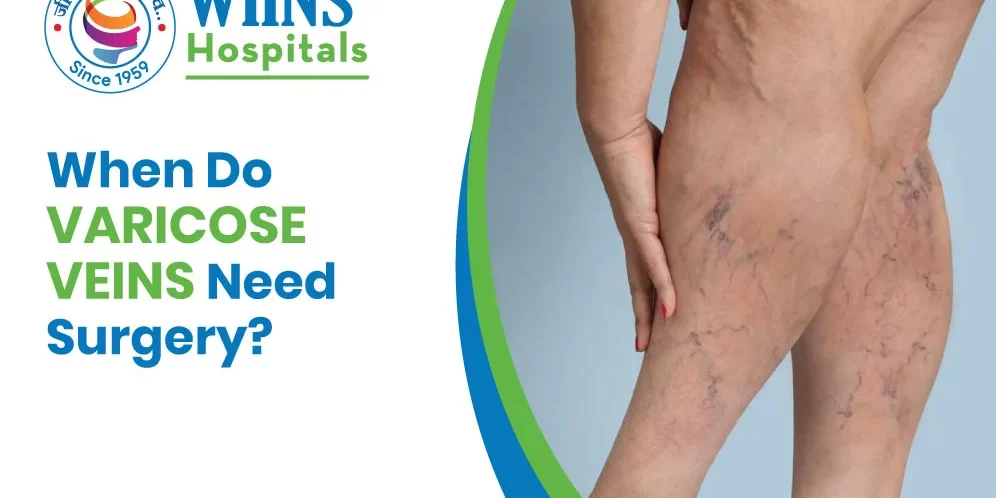
Varicose veins don’t always require surgery, but a procedure may be necessary if you have swelling, persistent pain and discomfort, or you develop venous ulcers or blood clots.
When Do Varicose Veins Need Surgery?
Do you notice swelling, redness, or a purplish or bluish vein in your lower legs? It could be varicose veins, usually harmless and nothing more than a cosmetic condition. However, varicose veins can cause significant and persistent discomfort. The veins might feel like a cord running through your legs.
At WIINs Hospital, our experts advise compression stockings, lifestyle changes, and other conservative treatments as first-line varicose vein treatment in Kolhapur. Surgery isn’t usually needed unless there’s a risk of complications.
What Causes Varicose Veins?
To understand what causes varicose veins, we need to understand the job of the veins that are right beneath your skin. Arteries bring blood from the heart to your body, while veins bring it back to the heart.
Now, veins in your legs have one-way valves that allow blood to move upward against gravity. When these valves weaken or become damaged, blood may start flowing backward. This builds up pressure in the veins, making them enlarged and visible beneath your skin.
There isn’t a single known factor that might cause varicose veins, but many factors can contribute to the risk. Known factors that might raise your risk include pregnancy, age, activities that require prolonged standing or sitting, overweight or obesity, family history, and a history of blood clots.
When Do You Need Surgery for Varicose Veins?
Here’s when surgery may be considered:
You Have Persistent Leg Pain: Do you have a dull ache or throbbing pain that won’t get better even with rest or elevation? Initially, doctors may recommend weight management, leg elevation, and compression stockings, but if nothing works and the pain interferes with your daily activities, they may consider a more invasive procedure.
There’s Visible Swelling: Many people with varicose veins report swelling in their lower legs and feet at night. It’s not the pain or swelling that occurs occasionally or after overexertion. Persistent swelling, even after rest, can be a sign that the valves in the veins are too weak to return blood to the heart. This may require medical evaluation and, probably, surgical treatment.
You Develop Venous Ulcers: Prolonged enlargement of the veins can lead to venous ulcers, which are open sores developing in the lower legs or ankles. These can be painful and may produce fluid. Treatment involves wound care followed by an appropriate surgical procedure for the enlarged veins to prevent ulcers from returning.
When a Blood Clot Develops: Varicose veins can sometimes cause an open sore wound in your lower legs or around the ankle, commonly called superficial venous thrombosis. The wound may be tender, painful, and warm. Note that it’s not similar to deep vein thrombosis (DVT), a condition that increases the risk of pulmonary embolism (a blood clot breaks off and travels to the lungs). However, people with varicose veins are slightly at an increased risk of developing DVT.
Surgical Treatment for Varicose Veins
For smaller veins, sclerotherapy can be used. It involves injecting a special foam solution into the affected vein to seal it. Radiofrequency ablation is another procedure used for larger varicose veins. It involves heat to seal off the varicose veins. Surgical ligation and vein stripping are other treatment options. For severe varicose veins, Ambulatory Phlebectomy (a surgery to remove the problematic vein) may be advised.
