

Septoplasty is a minimally invasive surgery that repositions and reshapes the deviated septum to provide relief from nasal blockage, sleeping issues, and recurring congestion. The surgery is advised when you have significant deviation that affects your quality of life.
Deviated Nasal Septum Surgery: When Do You Need Septoplasty?
Difficulty breathing through the nose, trouble sleeping, or feeling like one side of your nose is blocked are all common signs of a deviated septum.
Surgery is not necessary for a deviated septum unless you notice significant symptoms that won’t respond to conservative treatments. An ENT specialist in Kolhapur might recommend septoplasty, a surgery to straighten the deviated nasal wall, thus easing your symptoms.
How to Know if Your Septum is Off-Center
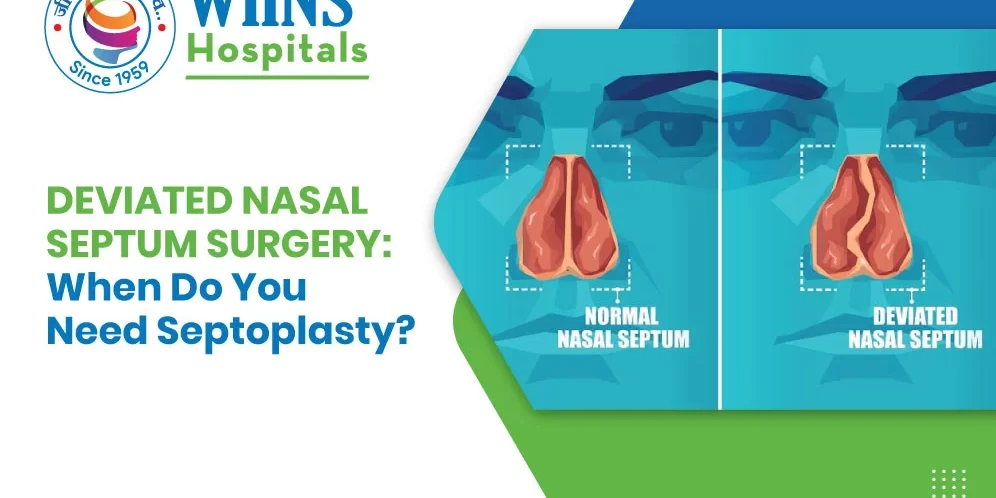
A septum is a wall made up of bone, cartilage, and other tissues at the center of your nose. It primarily separates the right and left nasal passages. A deviated septum is when this wall is off-center, i.e., crooked, tilted toward one side, or, in more complex cases, forming an S-Shaped curvature, making the wall uneven on either side.
It can be present from birth or develop after an injury to the nose, which shifts the septum. No matter which side your septum tilts toward, or how much it’s crooked, deviation can produce symptoms that might include:
- Congested nose
- Difficulty breathing comfortably through the nose (one side or both sides, depending on the extent of deviation)
- Mouth breathing
- Difficulty sleeping
- Snoring during sleep
- Postnasal drip
- Frequent nosebleeds
Symptoms tend to worsen when you have a cold or an allergic reaction, as the already restricted nasal passage may become narrower due to swelling.
Deviated Septum Treatment
An ENT specialist at WIINS Hospital will look into your nasal passage using an endoscope to determine if the issue is mild and can be treated with medication or if it requires surgical intervention. Mild congestion issues due to minor septum deviations can respond to nasal steroid sprays, decongestants, or antihistamines.
The only problem is that these are symptomatic treatments, which do not address the root cause. Besides, they may not work for everyone. The most effective treatment option for a deviated septum is septoplasty, which can be done through the inside of your nose.
Understanding Septoplasty
Deviated nasal septum surgery (septoplasty) in Kolhapur corrects the crooked septum without any external incision. The procedure involves careful lifting of the wall covering the septum, removing or repositioning the tissue that obstructs one side of the nasal passage, and reshaping the rest of the septum so that it straightens.
The exact surgical procedure depends on the extent, shape, and location of deviation, and may also include fixing other structural issues during the same operation, such as turbinoplasty to reduce enlarged turbinates.
Do You Need Septoplasty?
Whether you need septoplasty doesn’t just depend on the severity of nasal obstruction, but also on what you are expecting to achieve after treatment. Blocked nasal airways can impact your quality of sleep, which in turn can lead to poor concentration, restlessness, and irritability. If you want long-lasting relief, surgery to straighten the deviated septum is your best bet.
So, ask yourself, “Am I experiencing symptoms that can be relieved with symptomatic treatment, or does structural septum correction need to be done for permanent relief?