


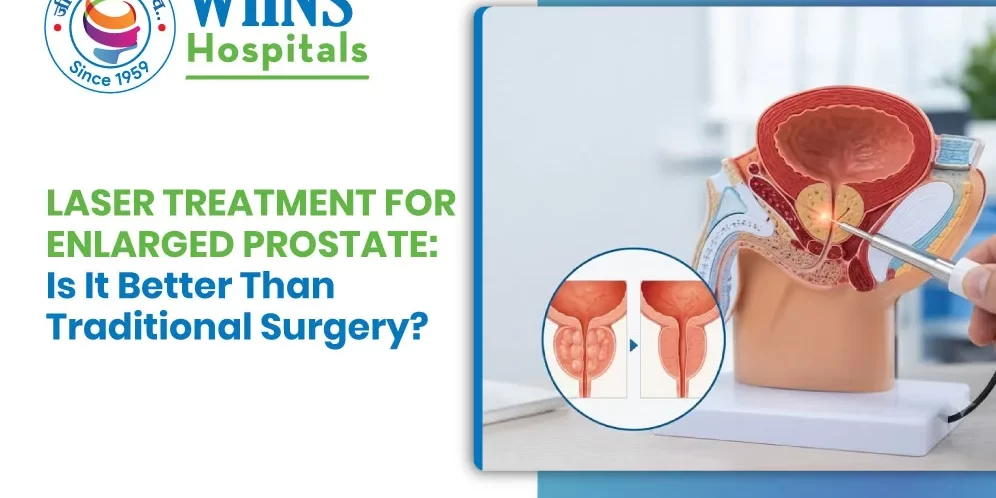
TURP and laser treatments are commonly considered for patients with an enlarged prostate. Both are widely used and share the same goal to remove extra prostate tissue, but the procedures, risks, and benefits may vary.
Is Laser Treatment for Enlarged Prostate Better than Traditional Surgery?
Enlarged prostate tissue is a common problem in older men. Since the urethra (the tube carrying urine) runs through the center of the prostate gland, enlargement of the prostate can squeeze this tube and restrict urine flow.
This can result in slower or more frequent urination. For most people with mild BPH, medication and conservative treatments are often effective in relieving symptoms. However, for significant enlargement, an enlarged prostate surgery in Kolhapur may be necessary.
Transurethral Resection of the Prostate
For several decades, Transurethral Resection of the Prostate (TURP) has been a standard treatment choice for Benign Prostatic Hyperplasia.
The latest advancements in the procedures, such as bipolar TURP that uses a bipolar electrical system to cut and remove the prostate tissue, have made it an effective treatment option.
At WIINS, the surgery involves inserting a thin tube through the urethra to access the prostate gland. The heated wire loop on the device shaves the prostate tissue, while the fluid washes away the fragments. Since it doesn’t involve an external incision, the surgery is considered a safer option for men with an enlarged prostate.
Laser Prostate Surgery
Laser surgery is a newer treatment option for patients struggling with urinary issues due to an enlarged prostate. The common types of laser procedures include:
- Photoselective Vaporization of the Prostate: It uses a high-powered laser device that vaporizes prostate tissue, all while sealing off blood vessels to control bleeding.
- Holmium Laser Enucleation of the Prostate (HoLEP): For men with an incredibly large prostate, this laser treatment might be an effective choice. The procedure separates the inner large portion of the prostate from the surrounding tissues. The removed tissues are broken into smaller fragments for smooth removal.
- Thulium Laser Prostatectomy (ThuLEP): ThuLEP uses a special laser instrument that targets enlarged prostate tissue, while minimizing damage to the surrounding healthy prostate tissue. It offers better precision.
Which One is Better?
Both have the same goals—to remove extra prostate tissue that blocks urinary flow. Their approaches may vary. TURP uses instruments that cut away extra tissue, while laser procedures use laser energy. Both involve passing instruments through the urinary tract rather than an open abdominal cut.
Is Laser Treatment More Effective for BPH than Traditional Surgery?
Laser, particularly HoLEP, is considered for very large prostate tissue that can’t be smoothly removed with TURP. Another major advantage of laser energy is that it seals off your blood vessels while removing prostate tissue.
This can help prevent bleeding, making it an appropriate treatment for patients with an increased risk of bleeding during surgery or those taking blood-thinning medicines.
That said, laser doesn’t completely eliminate risks. Difficulty passing urine, infection, or bleeding can still occur, just like in any surgery. The risk level varies from person to person and depends on the expertise of your urologist in Kolhapur.