


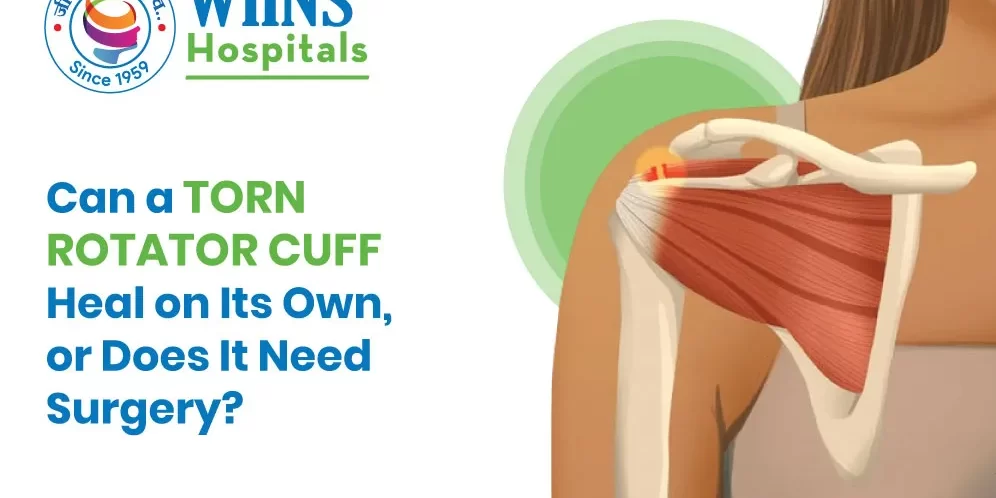
While the tendon itself can’t heal on its own, especially if it’s fully torn, surgery isn’t always needed for all torn tendons. The treatment focuses on improving the strength of the surrounding muscles and controlling pain and inflammation.
Can a Torn Rotator Cuff Heal on Its Own, or Does It Need Surgery?
Your rotator cuff is a set of tendons and muscles that play an integral part in allowing shoulder rotation and movement. If you are having difficulty moving your shoulder suddenly, especially when lifting your arm or extending it to grab objects, one of these tendons could have been torn.
While many patients heal with non-invasive treatments, some may require rotator cuff treatment in Kolhapur, specifically a surgical repair if you have a completely torn tendon.
How to Know If Your Rotator Tear Can Heal On Its Own?
It depends. The severity of the tear and your symptoms will help a doctor at WIINS Hospital determine if the tear can be repaired without surgery.
For example, for a minor tear, your doctor may prescribe anti-inflammatory medication, exercises to strengthen the surrounding muscles, and physiotherapy that rebuilds your shoulder strength, allowing you to restore most of your shoulder function.
If these do not work, corticosteroid injections are administered near the shoulder to provide temporary pain relief. This also enables you to participate in physiotherapy and restore your shoulder movement. However, injections cannot heal the torn tendon, nor can they reattach it to the bone.
If the tendon is completely torn, it’s highly unlikely that it will automatically reattach to the bone. Again, that doesn’t mean surgery is necessary for all. Oftentimes, the surrounding muscles compensate for the damaged tendon. Treatment usually focuses on restoring your shoulder function while relieving your symptoms.
When Does a Torn Rotator Cuff Require Treatment?
Here’s when an orthopedic surgeon in Kolhapurmay recommend rotator cuff tear surgery.
- Persistent Shoulder Pain: If you have severe or persistent shoulder pain that doesn’t respond to any conservative treatment, a surgical treatment may be considered, especially if the pain is keeping you up at night or interfering with your routine life.
- Muscle Weakness: If your shoulder movement is severely restricted, i.e., you are unable to lift your arms or carry objects, it’s worth considering a surgical repair.
- Complete Tear: If your rotator cuff is completely torn following an accident, fall, or an injury, an orthopedic surgeon may consider a surgical repair, especially in young people who need full shoulder strength back.
- Large Tear: Surgery may also be needed if you have a large tear that can affect muscle strength. Sometimes, a large tear makes your muscles weaker, making daily tasks challenging.
What Happens During a Rotator Cuff Tear Surgery?
The rotator cuff is mostly repaired through an arthroscopic surgery, where small holes are made around the shoulder, and specialized instruments are used to locate the damaged tendon and repair it.
The tendon is then reconnected to the upper arm bone with strong stitches and anchors. It’s performed under general anesthesia and sometimes in conjunction with a nerve block to control pain after surgery.
Initially, for up to 3-4 weeks, you may have to wear a sling to reduce strain on the operated shoulder. Movement is encouraged around 6-12 weeks after surgery, and most patients regain shoulder function within 4-6 months.