


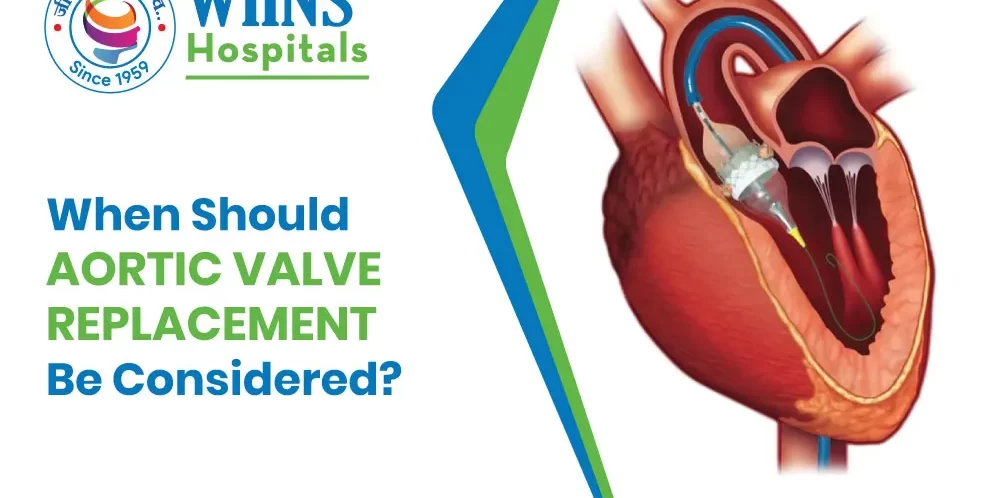
Aortic valve replacement is a heart surgery that replaces a stiff, narrowed, or leaking valve, thus improving blood flow from your heart to the body. It’s usually needed when your heart’s pumping ability has been compromised due to aortic regurgitation or stenosis.
When Should Aortic Valve Replacement Be Considered?
For several decades, the only effective option to treat aortic stenosis was open-heart surgery. In 2011, the FDA approved Transcatheter Aortic Valve Replacement (TAVR), a minimally invasive procedure that has become an option for those too sick to undergo major open-heart surgery.
Today, hundreds of thousands of TAVR procedures are done every year in the US alone. At WIINS Hospital, we have experienced cardiologists in Kolhapur who can perform regular heart surgery, as well as TAVR for aortic valve replacement. The question is, when exactly is this surgery needed?
Understanding Aortic Stenosis and Its Symptoms
Your aortic valve should open and close easily to allow blood to flow from your heart rather than collecting in the left ventricle. The valve can become narrower or too stiff to allow enough blood to reach your organs. This can push your heart to work harder to get enough blood pumped to your body.
As the condition progresses, you might start to experience certain signs, such as:
- Shortness of Breath: If you have started feeling breathless when walking, running, climbing stairs, or performing your routine activities, aortic stenosis can be a possible cause. If the valve leaks, pressure can build up in your heart, causing breathlessness.
- Chest Pain: Chest pain, discomfort, pressure, or a feeling of tightness are all signs of heart disease. Aortic stenosis can make your hard work harder, which may eventually cause chest discomfort.
- Dizziness: Fainting or dizziness, especially during physical activities, is another sign that your heart may be struggling to pump enough blood to your brain and other organs.
Although you may not necessarily need aortic valve replacement surgery in Kolhapur, the symptoms warrant a visit to a cardiologist for a thorough chest evaluation.
When is Aortic Valve Replacement Needed?
Here’s when a surgical intervention may be considered:
Severe Aortic Stenosis
When the valve is severely narrowed, the heart may push the blood through the stiff valve. This, in the long run, can put immense pressure on the heart muscles, thus weakening them. This can gradually raise your risk of heart failure.
Severe Aortic Regurgitation
Aortic regurgitation is when, instead of the blood flowing through the valve, it flows backward, collecting into the left ventricle.
A small leakage may not be problematic initially, but severe blood collection can enlarge it and affect its ability to pump blood effectively.
When Your Heart Can’t Pump Blood Efficiently
Severe aortic stenosis can affect your heart’s pumping ability. Even if you do not experience any noticeable signs of heart disease, if the test shows reduced heart function, an aortic valve replacement surgery may be considered.
A test called ejection fraction can reveal your heart’s pumping ability. Surgery is usually advised when the levels fall below 50 percent.
When You Have Another Heart Condition
Aortic valve replacement surgery may be performed alongside another surgery, such as coronary artery bypass, if medically necessary. Your cardiologist will consider your test results, age, health, and how rapidly the disease is progressing before recommending surgery.